Which decision should we improve first?
Bringing forward a harvest, changing a fertilization plan, buying inputs or accepting an order are decisions that commit resources and shape the margin. They are made with incomplete information, tight deadlines and consequences for other areas of the company. Improving them starts with choosing which one. The 2026 data help show where to look, and five questions help decide it in each company.
What the sector is looking for
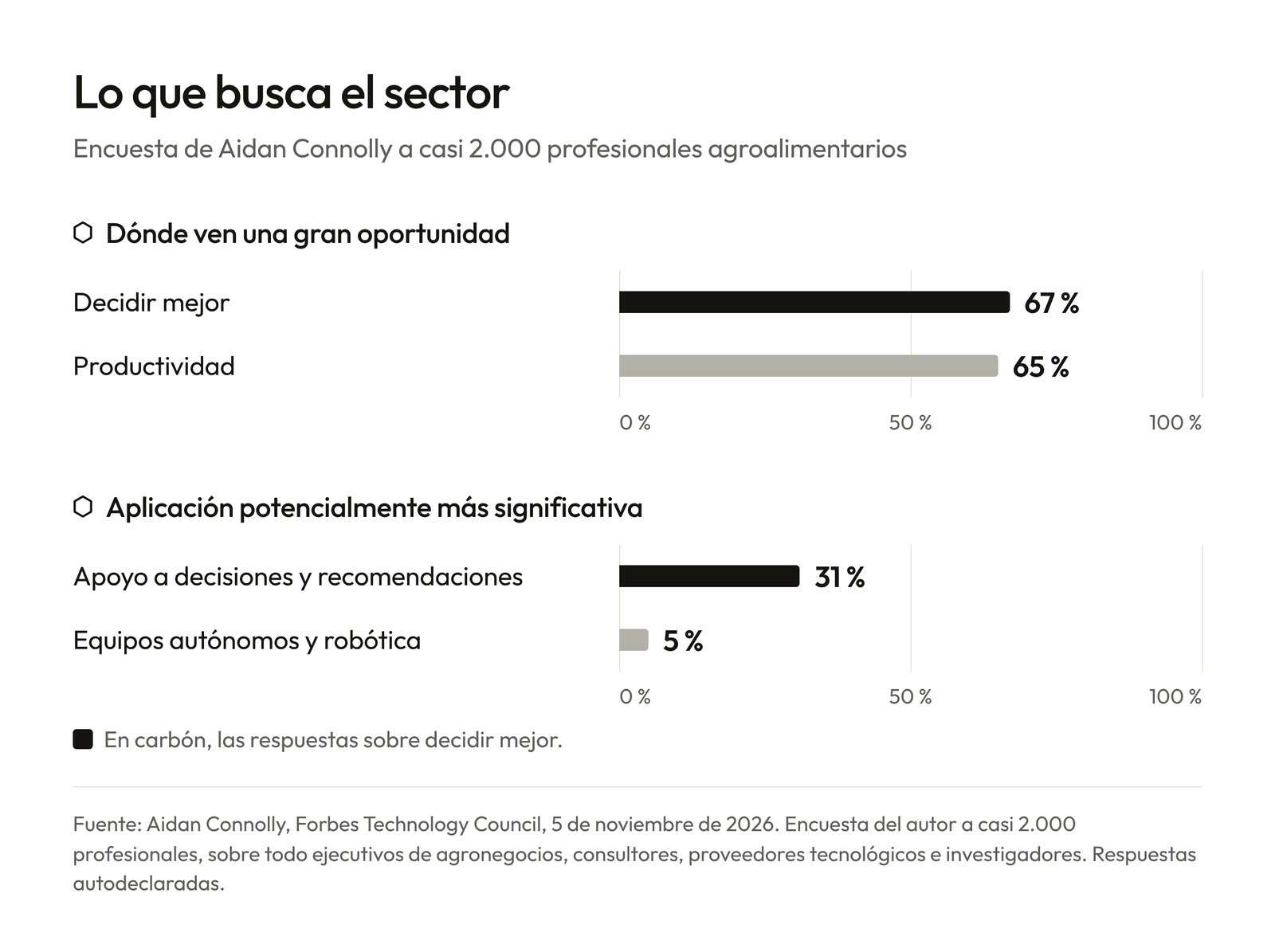
Aidan Connolly, chairman of AgriTech Capital, published on 5 November in Forbes Technology Council the results of a survey of almost 2,000 agrifood professionals, mostly agribusiness executives, consultants, technology providers and researchers. The responses are self-reported by people from the sector, and they point in a clear direction.
67% see better decision-making as a great opportunity and 65% see it in productivity. Asked about the potentially most significant application, 31% choose decision support and recommendations, and 5%, autonomous equipment and robotics.
Where usage stands today
29% of respondents have already used AI features built into software they already had, and 9%, a tool developed specifically for agriculture. The author himself believes the real figure may be higher and sees the most immediate opportunity in commercial decisions: purchasing, inventory and scheduling.
What to look after when starting
Among the obstacles respondents point to, the main one is a lack of knowledge or training (52%). Next, at 32%, come integration with existing systems and accuracy. These are three things that deserve attention from day one: training the people who will work with the proposals, connecting to the data that already exists and checking that what is recommended fits each operation.
Redesigning how work gets done
The McKinsey report The State of AI (August 2026, 1,719 participants from 97 countries), which Connolly cites, points in the same direction: almost three in four of the companies that get the most benefit from AI have thoroughly redesigned their workflows. Among the rest, one in four.
The starting point in Spain
In the Spanish food industry, the Observatorio de la Digitalización del Sector Agroalimentario (MAPA and Cajamar, June 2026) reports that 69.1% of companies had a digitalization strategy in 2025, compared with 36.3% in 2022. The plan is already in place in most of them. The next step is bringing it into daily work, into specific decisions.
Five questions to choose which decision to improve
Mercedes Iborra, co-founder and head of strategy at VisualNACert, picked up Connolly's idea with a question: which decision would we make differently if we could assess its technical and economic consequences in time? These five questions help answer it.
- Which decision repeats every season and weighs most on the margin? It is best to start with the recurring ones: when to harvest, which fertilization plan to apply, how much to buy, which order to accept. A decision made many times lets you learn from each repetition.
- Who makes it today, with what information, and how much does a mistake cost? Naming each part clarifies who decides, what they look at, what they are missing and what happens if it does not work out. That is usually where late information shows up.
- When will we know if it worked? The best candidates are decisions whose result can be seen soon, with reasonably good information and an acceptable cost of error.
- Who can accept, adjust or discard the proposal? A recommendation is useful when the person deciding can review it with the context in front of them: the plot, the crop, the market. Every operation is different, and the judgment of technicians and farmers is what shows whether a proposal fits.
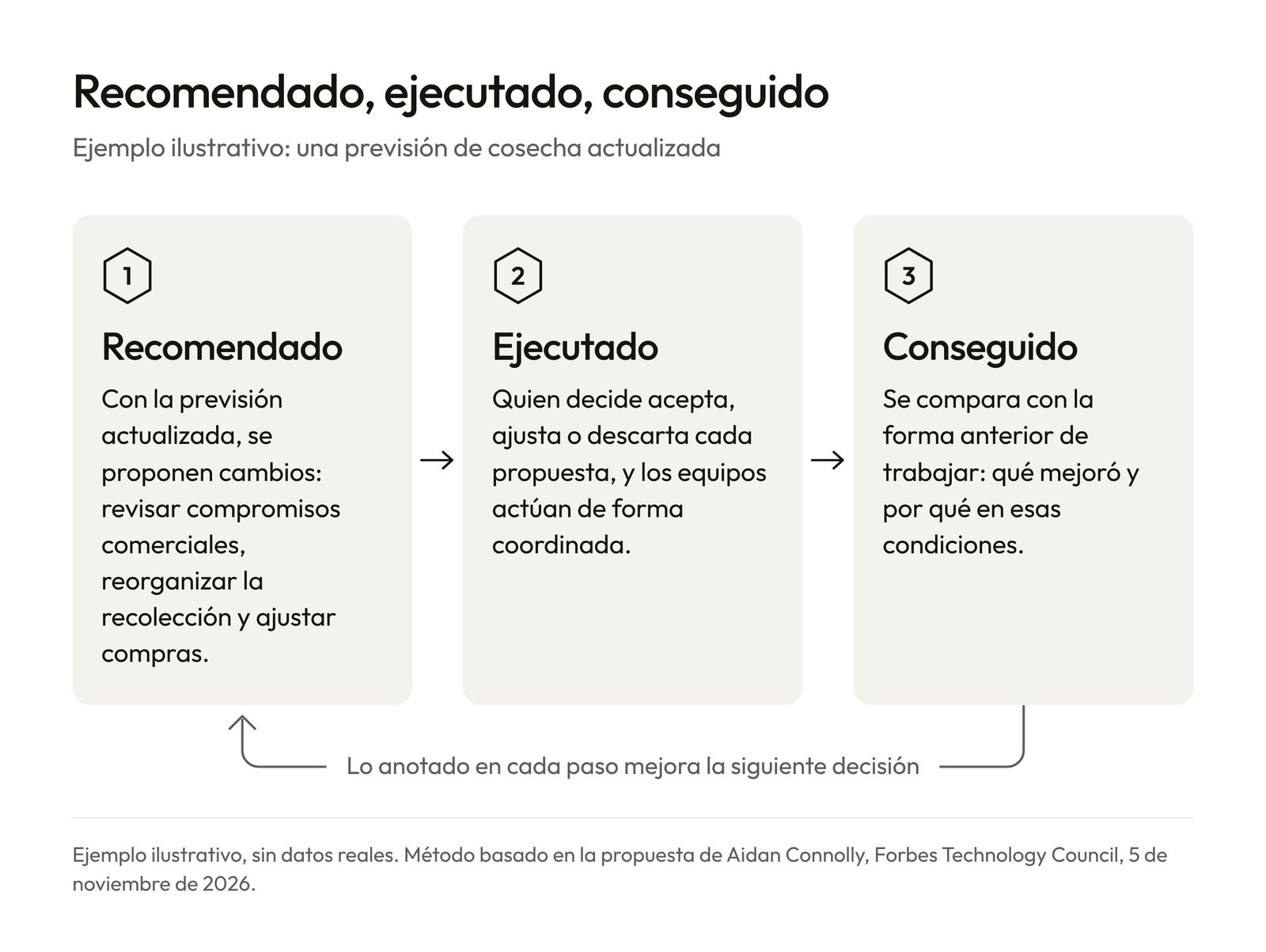
- What do we write down? What was recommended, what was done and what was achieved. Comparing it with the previous way of working shows where to expand and helps understand why something worked in some conditions and not in others. That is how trust is built: with repeated evidence.
An updated harvest forecast, for example, can lead to reviewing commercial commitments, reorganizing the harvest or adjusting purchases. The benefit depends on the information arriving on time, making it possible to choose a better alternative and translating into coordinated action.
Sources
- Aidan Connolly, "AI Is Agriculture's Next Big Opportunity. But Which Decisions Has It Actually Changed?", Forbes Technology Council, 5 November 2026.
- McKinsey, The State of AI (August 2026).
- Observatorio de la Digitalización del Sector Agroalimentario, MAPA and Cajamar (June 2026).
At VisualNACert we start from your operation to see which decision is worth improving first. If you would like to go over these questions with your own case, shall we talk?
Book a demo→