Mercedes Iborra interviewed in Las Provincias: from data to decision with agronomic judgement
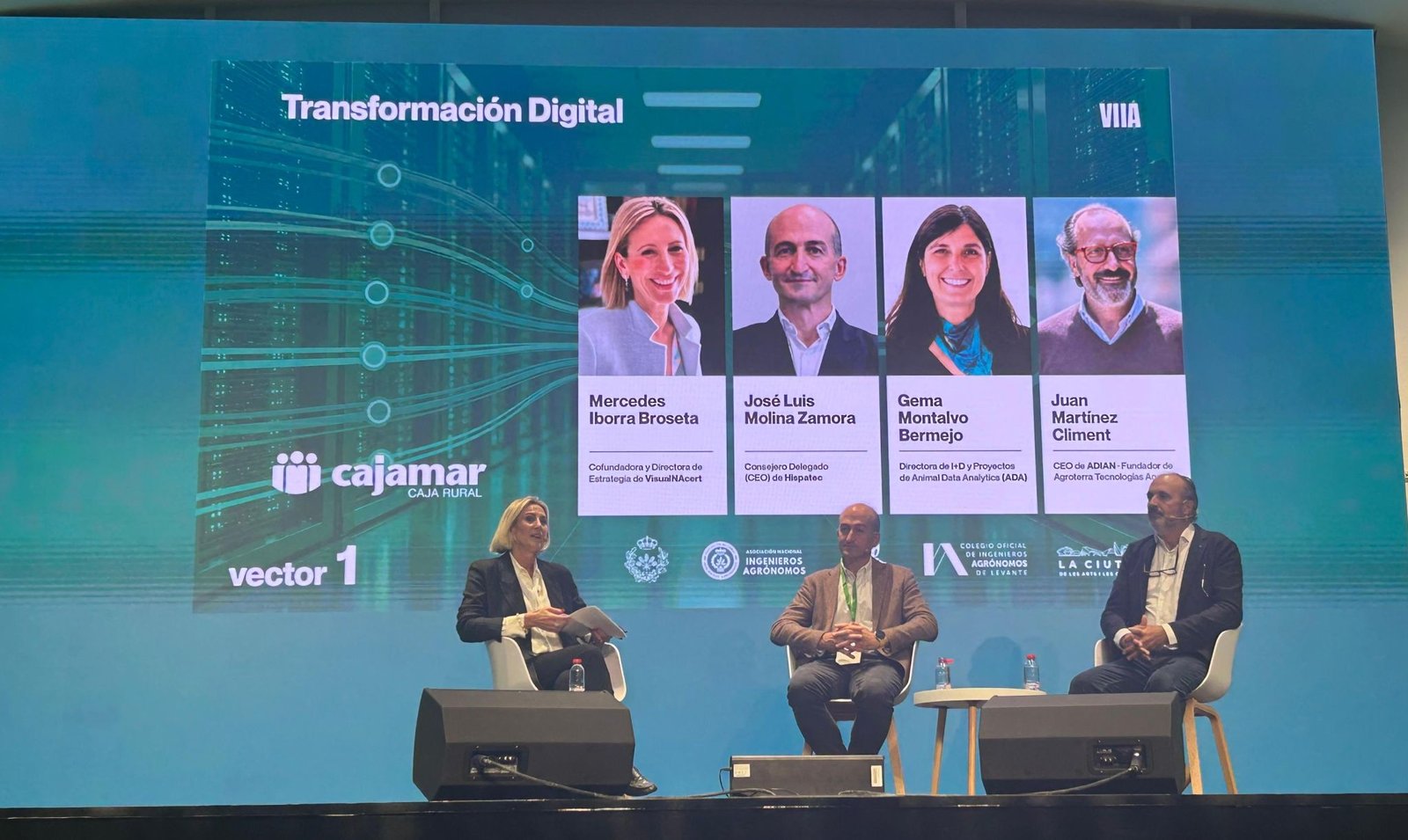
Las Provincias has published an interview with Mercedes Iborra, agronomist engineer and co-founder and Strategy Director of VisualNACert, following her participation in the 6th National Congress of Agronomist Engineers, held in Valencia from 27 to 30 October. Iborra took part in the congress's first vector, "Digital transformation: from what happens to the decision", alongside Juan Martínez Climent, CEO of ADIAN and founder of Agroterra Tecnologías Agrarias, and José Luis Molina Zamora, CEO of Hispatec. Her underlying idea: information is worth something when it changes operations and that improvement is sustained over time.
From what happens in the field to the decision
The report starts from an observation: a farm can now measure almost everything and yet there is still a gap between what happens in the field and the decision that gets made. Iborra puts it this way: "having information does not guarantee that we are making use of it". That is why she focuses on how information is built into the farm's daily routine and how the result is checked. For her, it makes practical sense for digitalisation to open the congress, "because it provides the base for applying many of the capabilities artificial intelligence offers us today".
Artificial intelligence, in her words, allows one more step: moving "from analysis towards recommendation". That step starts from knowing what you are after, whether raising productivity, improving quality, cutting losses or protecting margin. Her conclusion: "Value appears when information changes operations and that improvement is sustained over time".
A decision in production reaches all the way to the sale
The congress starts from the idea that living systems can no longer be analysed in compartments, and Iborra carries that idea across the whole chain: "A decision in production affects the quality of the food, its processing, costs and the possibilities of selling it". Her example is concrete: knowing how a harvest is developing can help organise resources, adjust industrial planning and respond to commercial opportunities. "If that information circulates and is used in time, the response capacity of the whole improves," she notes.
Uneven progress, even within the same company
Iborra sees advanced applications in feed and animal monitoring, precision agriculture, industrial automation and land observation, and points out that progress is uneven: "And, within those same organisations, we can find processes that still require a lot of manual work". The key, for her, is that improvements reach the whole: "An industry gains capacity if it knows better what it is going to receive; production can be better planned if it takes market needs into account".
Small farms and data ownership
For small farms, the answer starts somewhere else: "The first thing is that the improvement is clear". Investment, ease of use, training and support come afterwards. Iborra sees cooperatives, irrigation communities and technical services as a way to share capabilities and costs. On data, she states that "farmers must be clear about what information their activity generates, who can use it, for what purpose and how they can get it back", and reminds us that dependence on a platform appears when switching provider means losing the history.
When conditions change, agronomic judgement
With climate and trade changing the rules, the question arises of whether an artificial intelligence that learns from the past is any use for what it has never seen. Iborra argues that its usefulness "goes beyond looking for a similar season in the historical record", and calls for caution: "When conditions change a lot, we need to check how it behaves and review the trust we place in its results".
That is where she sees the role of the profession. An algorithm that does not understand biology "can optimise one variable and overlook its effects on others": producing more can look like a success until you look at what happens to quality, cost, resources used and final margin. "That is why agronomic knowledge must be part of developing the solutions," she stresses.
New roles for the profession
Looking ahead, Iborra sees opportunities in developing agronomic services with artificial intelligence, designing automated processes, supervising autonomous systems or leading the transformation of companies. She believes that "some will be new professions; others will greatly widen the scope of roles we already know". To make the most of it, she calls for updating training, bringing universities and companies closer together and giving young people the chance to work with these technologies.
The Colegio de Ingenieros Agrónomos de Levante (COIAL) has opened its series of interviews on the congress's twelve vectors with Mercedes Iborra, and will publish one every Friday.
Sources
- Las Provincias: Del dato a la decisión: reclaman su sitio en la era de la IA (in Spanish)
- COIAL: Arranca la serie de entrevistas sobre los doce vectores del VI Congreso con Mercedes Iborra (in Spanish)
Shall we talk about your case?
Tell us which crop you manage and we will show you how it applies on your farm, using data from your own plots.
Book a demo→