Profitability, water and generational renewal: VisualNACert joins the Economía 3 round table on the challenges facing agrifood
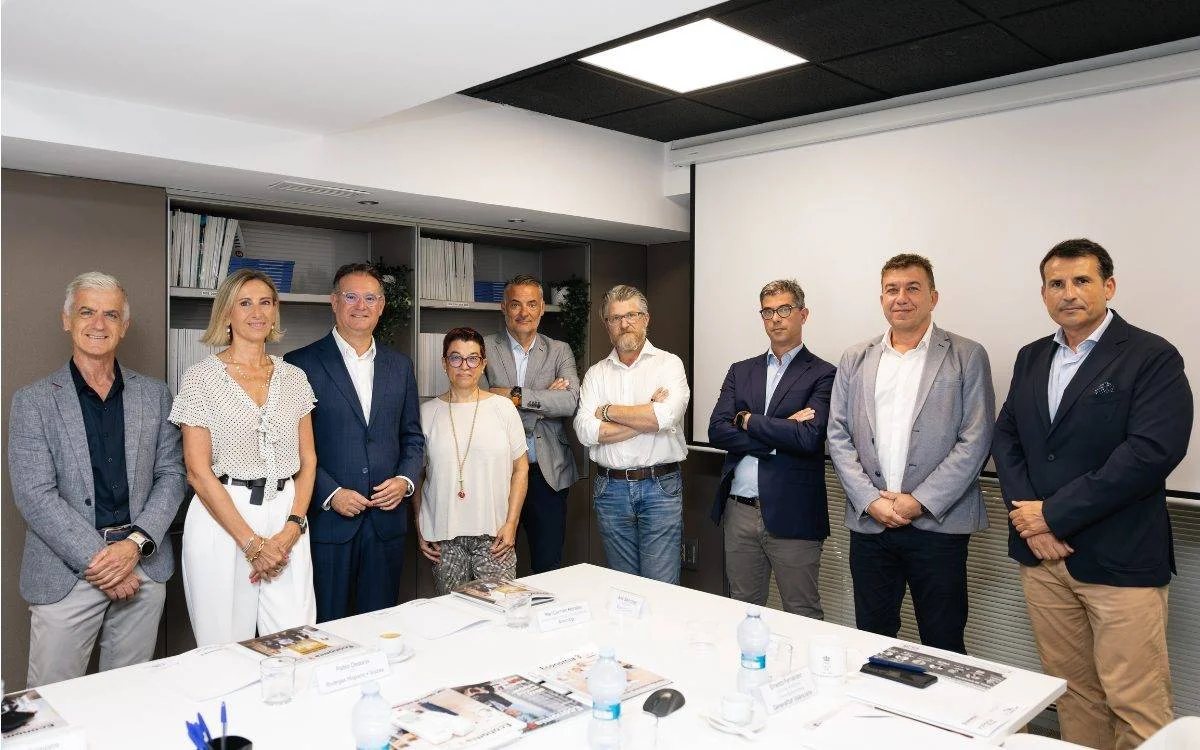
The Spanish agrifood industry already accounts for 9% of the economy, with added value of €137,387 million, more than 2.6 million jobs sustained and a record high of €79,391 million in exports. These are figures that speak of strength, but the round table organised by Economía 3 on 13 July at its Business Hub made clear that this economic weight sits alongside structural challenges that will not resolve themselves: profitability, water and generational renewal, with digitalisation running through all three. Mercedes Iborra, co-founder of VisualNACert, was one of the voices invited to the table, alongside representatives of the Valencia regional government, Fedacova, Anecoop, CaixaBank, PCS, Ogayar Consulting, Implica Corporate Finance and Bodegas Hispano Suizas.
Profitability first: competing on value, not on price alone
"The first element of sustainability is profitability," summed up Carlos Campos, director of AgroBank at CaixaBank for the Valencia region and Murcia, an idea that ran through much of the debate. Mari Carmen Morales, Quality and Sustainability Director at Anecoop, was equally direct: "Every one of our businesses has to focus on becoming more competitive." And Ernesto Fernández, Director General for Industry and the Agrifood Chain at the Valencia regional government, set out the sector's underlying challenge: "We have to compete on value, not on price alone," against productivity still below that of Europe's leading countries and R&D investment that remains limited.
Water, the industry's unfinished business
Water governance was flagged as one of the great unresolved tasks: the discussion covered technological efficiencies of up to 40%, the need to improve coordination between irrigation communities, and investment in reuse and desalination as routes to easing scarcity. Climate change, moreover, is shifting crops towards less traditional varieties, which forces a rethink of irrigation and cropping decisions that until now rested on a historical record no longer as reliable as it was.
Generational renewal: an average age of 67

The figure that best captures the industry's demographic challenge is the average age of growers in Spain, standing at 67, possibly the highest in Europe. Many businesses in the sector are small family structures with no clear internal successor, which leaves them at risk of disappearing — not for want of business, but for want of scale and continuity. The reading offered at the table was nonetheless more hopeful than resigned: the new generation arrives more comfortable with innovation and technology, which can turn the handover into an opportunity for modernisation if the industry manages to offer real reasons to stay.
"Knowledge is the cheapest investment available today"
Mercedes Iborra's contribution connected these three challenges — profitability, water and generational renewal — with digitalisation and artificial intelligence, in line with the diagnosis also made about the sector: digitalisation and AI are advancing at two speeds today, depending on how structured each organisation's data is. "Knowledge is the cheapest investment available today," she argued, an idea that sums up much of the VisualNACert proposition: before investing in more sensors or more infrastructure, many farms and cooperatives already hold the knowledge they need to decide better — only scattered, or unstructured. Iborra also offered the day's most vivid image: "The countryside is unwell, it needs plenty of doctors," a way of saying that the industry's challenges — profitability, water, succession — are not solved by a single diagnosis or a single tool, but by technical judgement applied methodically and sustained over time.
A €30 million line to make the leap
The session closed with a concrete announcement: a €30 million financing line with new forms of support accessed through a mutual guarantee society (SGR), which for the first time also opens access to large companies. It is a direct response to one of the challenges repeated throughout the debate: the industry's limited business scale, which restricts its capacity to invest in digitalisation, R&D or in generational renewal itself.
The underlying pattern the day left behind is the same one running through the rest of this editorial calendar: from the olive grove to the almond orchard, from citrus to rural areas at large, Spanish agrifood does not have a problem of missing data or missing available technology. It has a problem of structuring that knowledge and putting it at the service of whoever has to decide — whether about irrigation, about profitability or about who is going to inherit the farm.
Sources
- Economía 3 — Profitability, water and succession, the challenges facing the agrifood industry (in Spanish)
Shall we talk about your case?
Tell us which crop you manage and we will show you how it applies on your farm, using data from your own plots.
Book a demo→